
We recently discovered that the artifact cache at the Sinai P.O. contains not only ledger books and artifacts from Sinai, but ledgers from four other Anderson County post offices which had closed before it. (Remember, of the 35 rural post offices in Anderson County, Sinai was the last to close, in 1973). Within our one tiny P.O., there are historical artifacts from five.
Or are there?
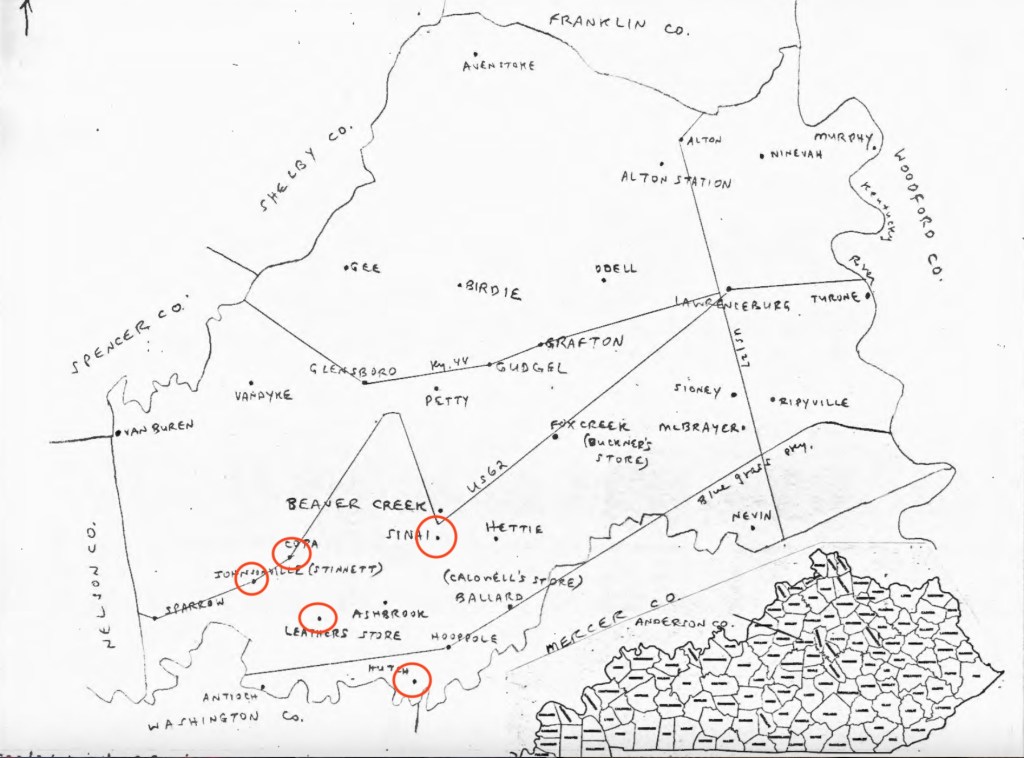
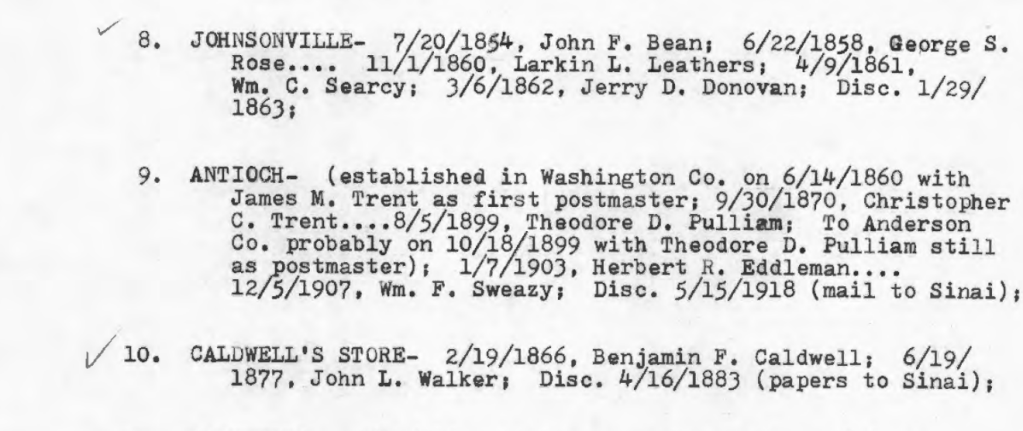
We’ve now confirmed that the Sinai artifact cache includes ledgers from post offices at Cora (1890-1912); Stinnett (1883-1913); Leathers’ Store (1876-1913); and Hutch (1908-1913). According to Rennick’s research, when each of these P.O.s closed, its remaining documents and business were directed to Sinai (pp. 17-18, see below for excerpted images).
To understand the significance of the discovery of ledger books from four other P.O.s, we have to remember the vital role rural post offices played in a time before phones, TVs, and cars were commonplace. Each P.O. served as a lifeline through which citizens communicated with friends and loved ones, received news, managed banking, conducted farm business, acquired medical devices (like glasses or prosthetics), ordered clothes, books, pictures, and furniture. Before machine-sorted mail and digital scanning, every transaction occurring in a given post office was painstakingly documented by hand. A few ledger books from a single P.O. offer a fascinating glimpse into life a century ago; many ledgers from multiple locations paint a rich picture of rural life across the county and provide a detailed genealogical record of this area in the late 19th and early 20th centuries.
(I am unaware of any such collection, anywhere in the U.S.A. That, in itself, is pretty amazing.)
But there’s more.
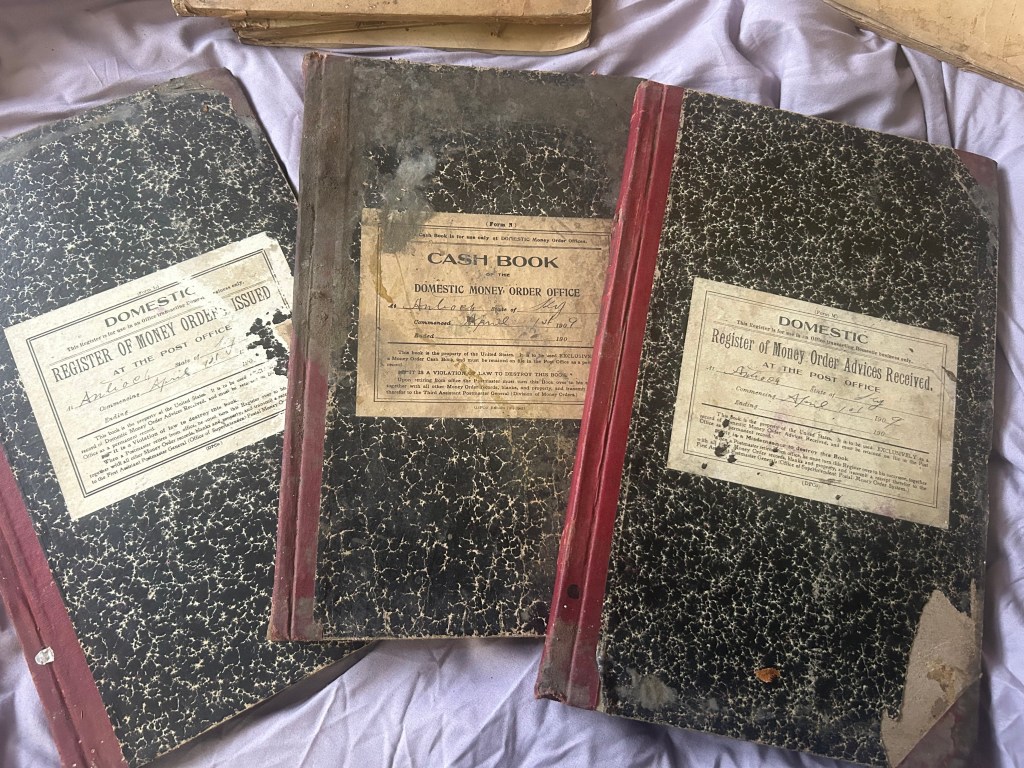
In the P.O. one February day, preparing for my visit from Julia Munguia at Spectrum News , I pulled out a few ledgers to display, and noticed that one said, “Antioch” on the cover. (EASTER EGG: If you watch Julia’s interview with me at the link above, you can see I’m actually holding that ledger book). That was a curious discovery because Antioch, KY wasn’t in Anderson County. Why would the Sinai P.O. have a ledger from a P.O. in another county? Was the Antioch P.O. among the ones which had thier business redirected to Sinai? Robert Rennick’s notes show the Antioch P.O. having been established in Washington County, but his hand-drawn map demarcates it just on the other side of the county line, in Anderson County, which added to my confusion. I needed to return to the Anderson County History Museum, and to Rennick.
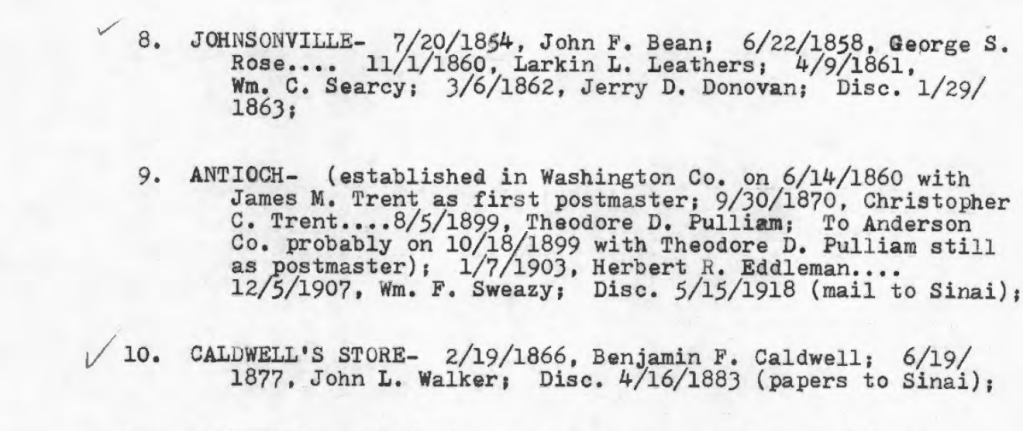
At Anderson County History Museum, Bob Crossfield and his brother, John, pointed out that (according to Rennick) the Antioch post office moved just across Sulphur Creek from Washington County to Anderson County in 1899. So, when it closed in 1918, the documents from the Antioch P.O. went to Sinai. Bob and John helped me confirm that my latest discovery represented another post office on Rennick’s map.
That’s six post offices represented in our artifact cache, if you’re counting (but don’t stop counting, yet).
During that visit with Bob and John, I had a pivotal realization: I need to stop looking for just “Sinai” information to understand Sinai’s past. I need to ground myself in the bigger picture and understand Sinai and its people in the context of their relationships to one another, and to other places (especially the other P.O.s).
I returned to Rennick’s notes with fresh eyes, reading about every post office in the county. Another realization dawned on me.
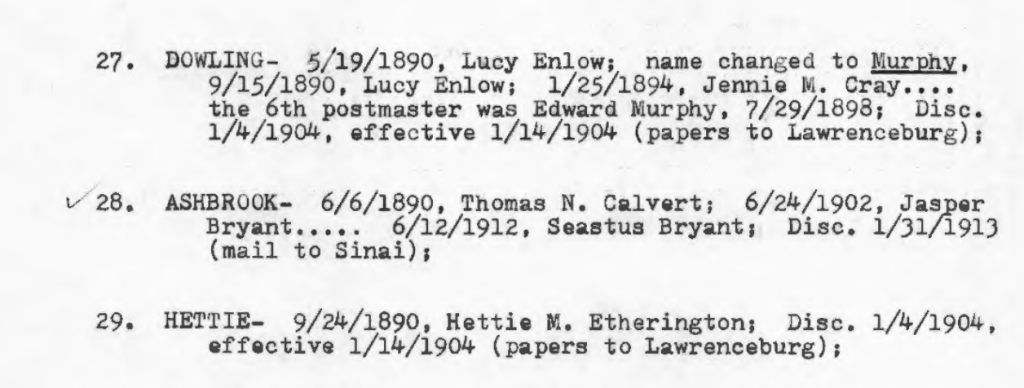
According to Rennick, two other P.O.s had redirected their business to Sinai when they closed: Ashbrook (1890-1913), and Caldwell’s Store (1866-1883).
The Sinai P.O. may still include materials from two other post offices.
More to come!

Leave a comment