
Community Campaign Days 12 & 13: Make Your Gift Now!
One of the most compelling artifacts in the OSPO cache is the Benson Groves “Wanted” poster, in part because it opens with such thrilling detail: “On November 7, 1935, five bandits armed with a machine gun, a sawed-off shotgun and pistols, held up Detroit & Pittsburgh R.P.O. Train 626 at the Erie Railroad Depot in Garrettsville, Ohio, and escaped with valuable registered mail.” That description of Groves’ crime, combined with a near astronomical reward amount (roughly the equivalent of $50,000, today) and a riveting mugshot of a gangster with light eyes and thick eyebrows, arched like Appalachian foothills, makes this piece one of the most arresting in the collection (pun intended).
The poster, dated November 13, 1939, notes that the included image of Groves is nearly a decade old. The accompanying text describes him as a stoop-shouldered man in his mid-60s with glasses, graying hair, coarse features, azure eyes, and tattoos on both forearms. It warns readers that Groves has three aliases–Benjamin Greyson, B.J. Greyson, and George Wilson–but is best-known by one of two simple nicknames: “Old Ben” or “Soup.”
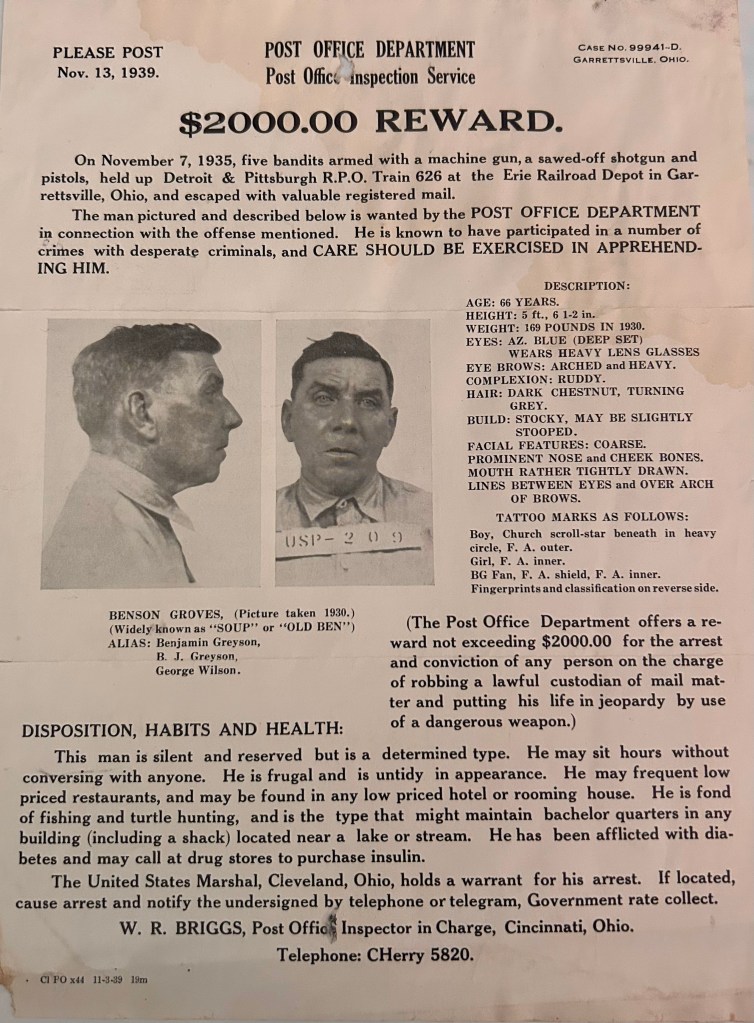
At first, the nickname surprised me: “Soup” seems an unexpectedly mild moniker for a dangerous criminal who robbed trains while armed to the teeth, especially in an era in which other known gangsters held titles like “Mad Dog” (Vincent Coll) and “Machine Gun Kelly” (George Kelly Barnes). Even “Baby Face” Nelson and “Pretty Boy” Floyd’s nicknames, while literal, contrasted with reliable irony against their violent crimes. Why would Groves end up named after this seemingly innocuous category of food? And why, when hundreds of “Wanted” posters circulated through tiny P.O.s like mine in the early 20th century, would the postmaster have kept this one? What makes the story of Benson “Soup” Groves so special?
The first thing I learned was that, in the context of 1930s gangsterdom, “soup” connotes terrible volatility and destruction because it refers to nitroglycerin. Specifically, it refers to the nitroglycerin extracted from TNT and used by safecrackers to blow bank safes during robberies (historicalcrimedetective.com). A robbery requiring a safe to be blown up was known as a “soup job” and the operator performing the nitroglycerin extraction, known as the “soup man” or simply, “Soup.” The nickname infers that either Groves was a volatile and destructive man, which lines up with the behavior outlined above; or that he had potentially operated as a soup man as part of his role in a gang (a reasonable possibility, given that he was a career thief “five bandits” who robbed the train.
As it turns out, Benson Groves, a.k.a Ben Greyson (alternatively spelled, “Grayson”), was not only a gang member. “Old Ben” was a bank robber and a member of one of the most extensive and notorious criminal networks of the 1930s: the Barker-Karpis gang. The Garrettsville holdup he’d been involved in during November of 1935 is now known as “America’s Last Great Train Heist.”
According to Northeastern Ohio Historian, Julie A. Thompson, Alvin Karpis (whose nickname was, straightforwardly, “Creepy,” for his chilling stare) involved himself in “fifteen bank robberies, fourteen murders, three jailbreaks and two kidnappings” throughout his criminal career. Thompson’s book, The Hunt for the Last Public Enemy in Northeastern Ohio: Avin “Creepy” Karpis and His Road to Alcatraz, tells the story of the extensive criminal enterprise established by Karpis and his partner, Fred Barker, throughout the early 1930s. The gang later included Barker’s brothers, aided by their mother, Kate “Ma” Barker. Karpis’ prolific crimes placed him right in the sites of the newly established Federal Bureau of Investigation, and its director, J. Edgar Hoover. When Lester “Baby Face” Nelson was killed in 1934, Alvin Karpis became Public Enemy Number One. (Of the four men to hold the title, Karpis was the only one taken alive).
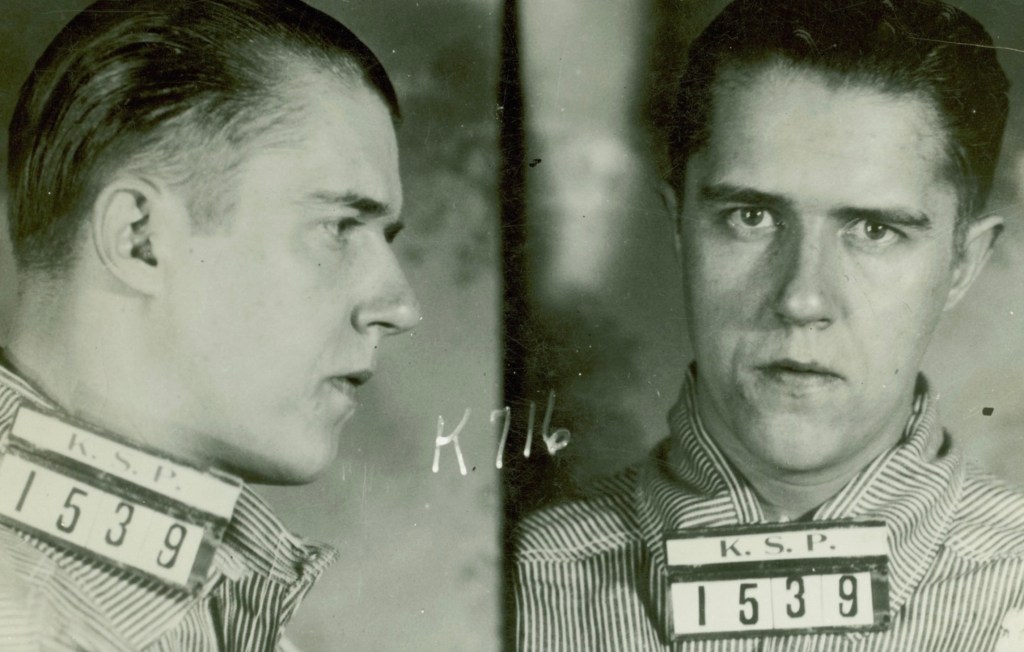
(Image from FBI History: Barker-Karpis Gang)
By 1935, many of the members of the Barker-Karpis network had been killed and some had been incarcerated. Fred and Ma Barker were gunned down during a shootout with FBI agents in Florida. Alvin Karpis, however, remained at large. After a near-miss during a shootout with federal authorities in Atlantic City, Karpis took refuge in Northeast Ohio, outside Cleveland. Flush from recent jobs but knowing the FBI would close in before long, Karpis planned an elaborate train robbery. “I was aching for an exciting heist” Karpis later said in his autobiography, Public Enemy Number One: The Alvin Karpis Story.
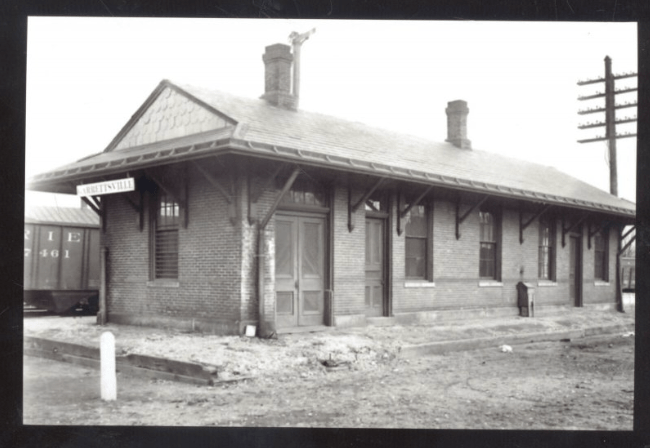
(Postcard of Erie Train Depot in Garrettsville, OH)
He identified the Detroit & Pittsburgh R.P.O. 626 Train as an outstanding target because the mail train carried payrolls for several large industries in Warren and Pittsburgh, plus registered mail. Karpis carefully researched the train, its schedule, and cargo, deciding to rob it during a scheduled stop at the Erie Train Depot in Garrettsville, Ohio. He bought a new Plymouth (but would have preferred a new Ford with a V-8, desirable for its getaway speed). He recruited a crew: among its members, Ben Grayson (a.k.a Benson “Soup” Groves). Hearing Karpis’ bold plan to hold up a train “in the fine style, just like the famous old Western bandits,” Grayson responded, “Who the hell in this day and age robs a train?”
On the afternoon of November 7, 1935, when the train pulled into the depot at Garrettsville, each member of the gang was prepared for their assigned role. A six-year-old boy boy, who witnessed the train robbery from his home across from the depot, saw Tommy guns pointed out each window of the Plymouth as the gang put their plan into action. While Karpis went for the score, Ben Grayson, heavily-armed and wearing a comically-fake, long, droopy mustache, occupied the engineer and fireman, keeping them quiet and unable to sound an alarm. Karpis, from outside the mail car, shouted at the three clerks inside it to cooperate and turn over the payrolls and registered letters. When they refused, he threw an unlit stick of dynamite into the car, hollering that the next one would be lit.
Ultimately, the gang pulled off the heist but came away with less than they’d expected. The payrolls had been delivered on the previous day, so their haul was limited to their profit from the registered mail they’d stolen. They made off with $46,000; just over one million dollars in 2026. More importantly, they’d accomplished Karpis’ goal to successfully carry out an old-fashioned train heist like legitimate bandits.
Having accomplished their goal, the gang members quickly split up. Karpis and his friend and accomplice, Fred Hunter, flew a waiting Stinson plane out of town; but with the FBI and now the postal inspectors hunting him, Karpis’s days of freedom were limited. He never pulled another heist, and by 1936, J. Edgar Hoover had personally apprehended Alvin Karpis in New Orleans. All the other members of the Garrettsville Train Depot Robbery, what came to be known as “America’s Last Great Train Heist,” had been killed or apprehended. All except Ben Grayson: a man whose real name was Benson Groves.
Benson Groves got lost after that. I haven’t been able to find any information on his whereabouts between the time of the robbery and the distribution of the OSPO’s “Wanted” poster in 1939. By then, “Soup” was the last of the Karpis train heist gang still at large, which explains the extraordinary reward amount. (Karpis had already been in Alcatraz three years.)
Then, recently, I found this 80-year old photo for sale online.
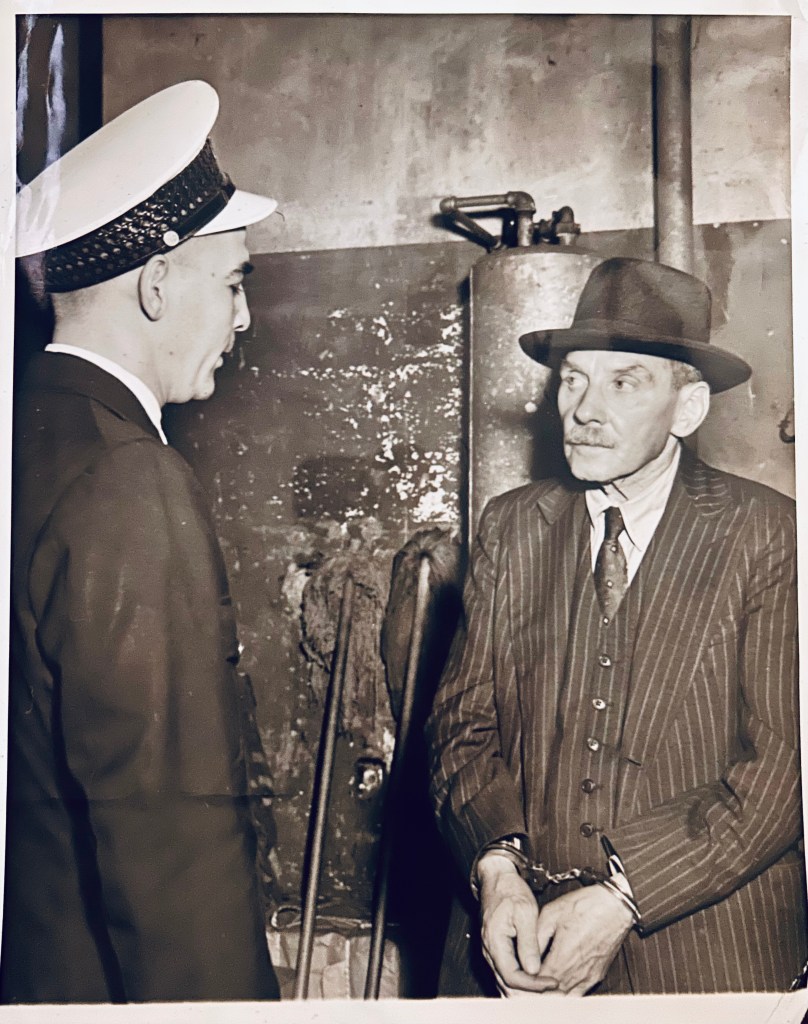
Groves is older in this photo. Instead of prison blues, he wears a plain snapbrim fedora, a dapper three-piece suit, and a graying mustache. He has the same heavily arched brows and bright eyes, which are keenly aimed at his escort, Patrolman Otto Eschenbach.
This official Associated Press photo from Chicago, dated October 1, 1941, shows the final capture of “Hunted Karpis Gangster, Benson ‘Soup’ Groves.” At 68, Groves attempted to rob a bank in a suburb of Cincinnati but was thwarted by the manager and some local firemen, who disarmed him and contacted authorities.
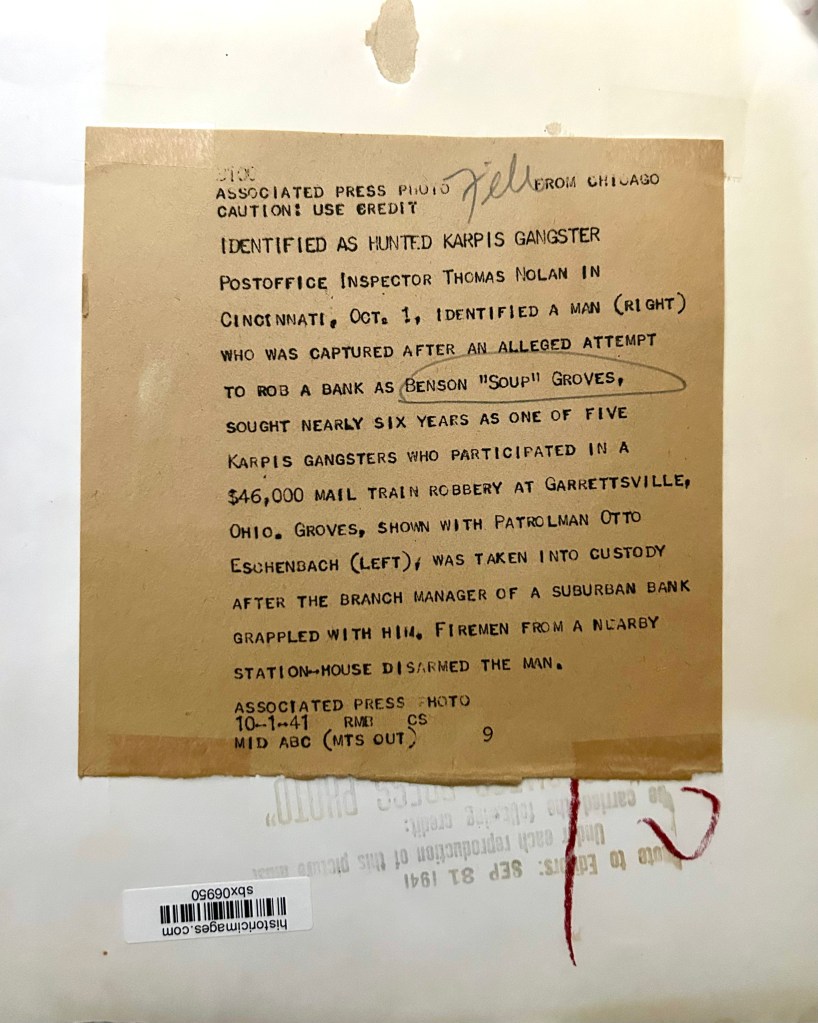
(Originals of this photo and its note are now in the OSPO collection with the Groves “Wanted” poster)
Of the gangsters who committed the daring and carefully orchestrated “Last Great Train Heist,” Benson “Soup” Groves (a.k.a Ben Grayson) was the last man standing. Arguably, his 1941 capture signified the end of the glorious era of the American gangster.
Now, it’s abundantly clear why this “Wanted” poster is historically significant, but that only makes me more curious about the postmaster/mistress who kept it and the personal significance it may have held for them.
More soon!
JH


Leave a comment